Creative Profiles
Tristan Eaton: The Muralist Who Built a Brand Empire
Liz Plummer9 min read
Brian Donnelly started by defacing bus shelter ads in New York. He ended up building one of the most commercially successful art practices in the world.

Arts & Business Contributor
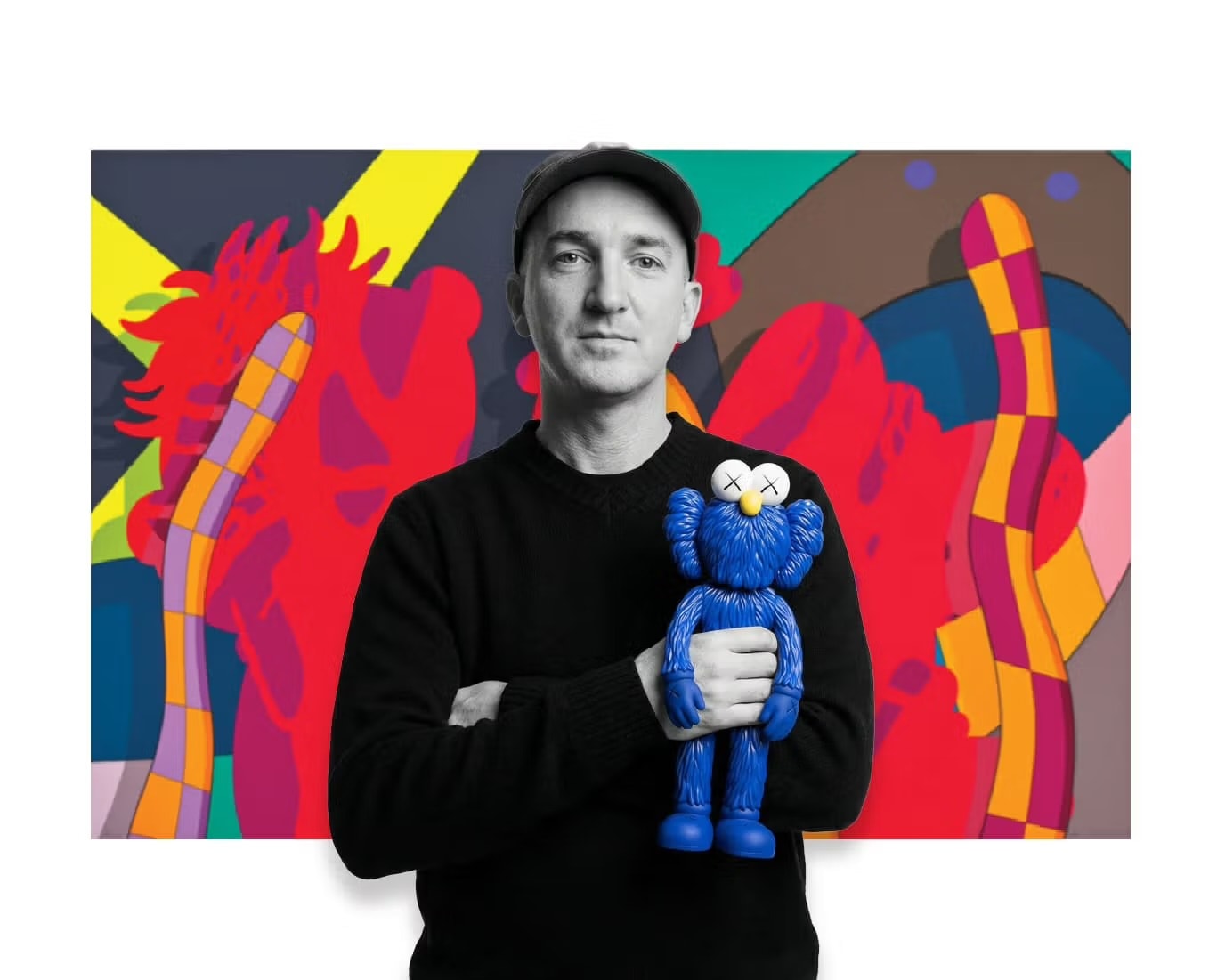
In the mid-1990s, a teenager from Jersey City named Brian Donnelly was doing something that would get him arrested if caught. He was breaking into bus shelter advertising cases across New York City, removing the posters inside, taking them back to his apartment, painting over them with his own characters, and then returning them to the shelters. The ads would go back up, looking almost normal, except that the faces had been replaced with cartoon skulls and crossed-out eyes.
He signed them KAWS. Nobody knew who he was. That was part of the point.
Three decades later, KAWS is one of the most recognizable names in contemporary art and one of the most commercially successful creative practices in the world. His sculptures sell at auction for millions of dollars. His collaborations with Nike, Dior, Uniqlo, and Supreme have generated hundreds of millions in revenue. His vinyl figures, once sold at small toy shops, now command thousands of dollars on the secondary market. A 2019 auction at Sotheby's Hong Kong saw his painting "The Kaws Album" sell for $14.7 million, more than 100 times its estimate.
"He was not trying to build a brand. He was trying to make work that felt honest. The brand followed from that."
Donnelly grew up in Jersey City and showed an early aptitude for drawing. He enrolled at the School of Visual Arts in New York, where he studied illustration, and graduated in 1996. By that point he had already been doing his street interventions for a couple of years, developing the visual language that would define his career: the XX eyes, the cartoon proportions, the characters he called Companions.
The street work was not just vandalism. It was a genuine artistic practice, one that engaged with the visual language of advertising and popular culture in a way that was simultaneously critical and affectionate. Donnelly was not rejecting commercial imagery. He was in conversation with it, inserting his own characters into the spaces that brands had claimed, asking what happened when you replaced a corporate message with something personal.
After graduating, he got a job as an animator, working on shows including 101 Dalmatians: The Series and Daria. The work paid the bills and gave him a deep technical education in character design and animation. But the street work continued, and it was starting to attract attention.
In the late 1990s, KAWS traveled to Japan and discovered a culture that was uniquely receptive to what he was doing. Japanese streetwear and toy culture had developed a sophisticated appreciation for the intersection of art, design, and commerce that did not yet exist in the same way in the United States. Brands like A Bathing Ape were already blurring the lines between fashion, art, and collectibles.
He began collaborating with Japanese brands, producing limited-edition products that sold out immediately. The vinyl figure business started here, with small runs of Companion figures that were sold through boutiques in Tokyo and Osaka. The demand was immediate and intense. People were lining up.
What KAWS understood, perhaps before most artists of his generation, was that the collectible object was a different kind of art distribution. It was not a print or a poster. It was a three-dimensional thing that people could live with, display, and trade. It had the emotional resonance of a toy and the cultural cachet of art. And it could be produced in editions that made it accessible to people who could never afford a painting.
One of the most interesting things about KAWS as a business story is how deliberately Donnelly avoided the language of branding and commerce even as he was building one of the most effective creative brands of his era. He was not trying to build a brand. He was trying to make work that felt honest. The brand followed from that.
The collaborations were always selective. When Nike came calling, Donnelly did not simply license his characters for a generic product. He worked closely on the design, ensuring that the result felt like a genuine creative collaboration rather than a logo placement. The same was true of his work with Dior, which produced a collection that felt coherent with both the KAWS aesthetic and the Dior heritage. These were not cash grabs. They were creative projects that happened to generate significant revenue.
The Uniqlo collaboration deserves particular attention. By partnering with a mass-market retailer to produce affordable T-shirts featuring his characters, KAWS made a deliberate choice to democratize access to his work. The shirts sold for around $20. They sold out globally within hours. The queues outside Uniqlo stores in cities around the world looked more like sneaker drops than clothing retail. It was a masterclass in scarcity, accessibility, and brand desire operating simultaneously.
For years, the fine art world maintained a certain skepticism about KAWS. The work was too popular, too commercial, too accessible to be taken seriously by institutions that prized difficulty and exclusivity. That skepticism has largely evaporated.
Major museums have exhibited his work. Auction houses have set records with his paintings and sculptures. The critical conversation around his practice has matured, recognizing that the engagement with popular culture and commercial imagery is not a limitation but a central subject. KAWS is doing something that has a serious art historical lineage, from Warhol's soup cans to Koons's balloon animals, but he is doing it with a visual language that is entirely his own.
The large-scale public installations have been particularly significant in this regard. KAWS: HOLIDAY, a series of giant inflatable Companion figures installed in locations including Hong Kong's Victoria Harbour, Seoul's Lotte World Tower, and Taipei, drew massive crowds and generated enormous media coverage. These were not gallery shows for art world insiders. They were public spectacles that brought his work to millions of people who had never set foot in a contemporary art museum.
The business lessons embedded in the KAWS story are worth examining carefully, because they run counter to some conventional wisdom about how creative careers are built.
Consistency matters more than novelty. The XX eyes and Companion characters have been present in KAWS's work for thirty years. He has not chased trends or reinvented himself to stay relevant. The visual language has evolved and deepened, but it has remained recognizably his. In a culture that rewards constant reinvention, his commitment to a coherent visual identity has been a competitive advantage.
Accessibility and exclusivity can coexist. The $20 Uniqlo shirt and the $14 million auction painting are both genuine KAWS products. They serve different markets and create different relationships with his work, but they reinforce each other. The person who owns the shirt feels connected to something that also exists at the highest levels of the art market. The collector who paid millions knows that their investment is supported by a global community of fans.
Collaboration is a creative act, not a commercial compromise. Every major KAWS collaboration has been treated as a genuine creative project. The results show it. When the work is good, the commercial success follows. When the commercial success is chased at the expense of the work, the audience notices.
Brian Donnelly started by putting his characters where nobody asked for them, in the spaces that brands had claimed as their own. He ended up building something that those same brands would pay generously to be associated with. The arc of that story, from unauthorized intervention to global creative institution, is one of the more remarkable in contemporary art and business.
He never stopped making the work. Everything else followed from that.
About the author
Liz PlummerLiz Plummer is an executive producer, creative director, and arts contributor. She covers contemporary artists, design, architecture, creative entrepreneurship, and the cultural forces shaping modern business.