Creative Profiles
KAWS: From Graffiti to Global Brand
Tamara Edwards10 min read
From a guerrilla sticker campaign to a global clothing brand, a fine art practice, and the defining political poster of the 2008 election, Fairey has spent thirty-five years proving that art and commerce are not opposites.

Arts & Business Contributor
In 1989, a 19-year-old art student at the Rhode Island School of Design printed a sticker featuring the face of professional wrestler Andre the Giant alongside the word OBEY. He pasted it on walls, skateboards, and street signs around Providence. He had no particular message in mind. The point, he later explained, was simply to make people notice something they had not noticed before, to interrupt the visual landscape and make a viewer ask why.
That sticker became one of the most recognizable images in street art history. The OBEY Giant campaign spread from Providence to cities around the world, evolving from a guerrilla sticker campaign into a global brand, a clothing line, a gallery practice, and eventually one of the most commercially successful creative enterprises in contemporary art. Shepard Fairey had stumbled onto something important: the power of a simple, repeatable image deployed at scale.
"I want to make work that makes people think. If it also makes them feel something, that is even better."
Fairey's career has always operated at the intersection of art, commerce, and politics, a space that makes many people uncomfortable and that he has navigated with unusual skill. His OBEY clothing brand, launched in 2001, generates tens of millions of dollars in annual revenue while maintaining the aesthetic credibility of a street art operation. His studio, Studio Number One, has produced campaigns for clients ranging from Levi's and Hasbro to environmental organizations and political campaigns.
The moment that defined Fairey's public profile came in 2008, when he created the Hope poster for Barack Obama's presidential campaign. The image, a stylized portrait of Obama in red, white, and blue with the word HOPE beneath it, became the defining visual artifact of that election cycle. It appeared on magazine covers, in museum collections, and on walls around the world. The Associated Press later disputed the copyright of the photograph Fairey had used as a reference, leading to a legal settlement that became its own chapter in the ongoing conversation about appropriation, authorship, and artistic practice.
Fairey's relationship with brands has been one of the most studied in contemporary art. He has collaborated with companies including Pepsi, Levi's, and Hennessy, and has been criticized by some in the street art community for what they see as a contradiction between his anti-establishment imagery and his commercial partnerships. Fairey's response has been consistent: the goal is to use the reach that commercial work provides to amplify messages that matter. The OBEY brand funds the studio. The studio funds the activism.
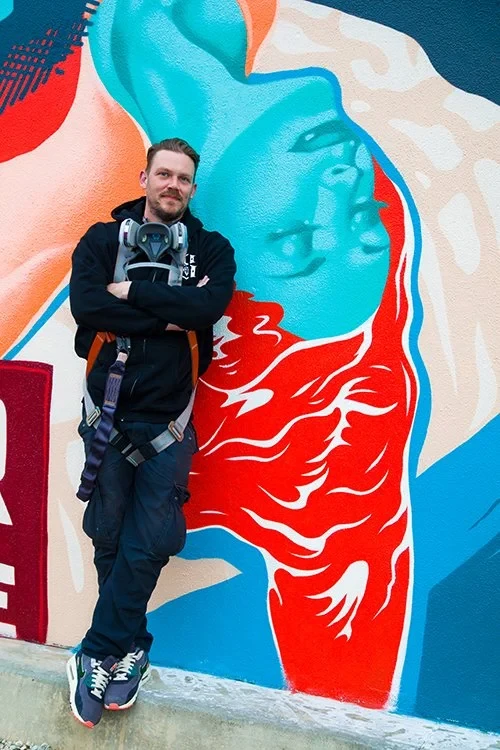
His environmental work has become increasingly central to his practice. Large-scale murals addressing climate change, biodiversity loss, and corporate accountability have appeared in cities from Los Angeles to Paris. These are not simply decorative works. They are designed to be photographed, shared, and discussed, to function as public conversation starters in the same way the original OBEY stickers did, but with a specific political purpose.
What Fairey has built over three decades is something genuinely unusual: a creative practice that is simultaneously a fine art career, a commercial design business, a clothing brand, and a political communications operation. Each element reinforces the others. The street art gives the brand credibility. The brand funds the studio. The studio produces the political work. The political work generates the cultural conversation that keeps the street art relevant.
Few artists have figured out how to make those pieces fit together. Fairey has been doing it for thirty-five years.
About the author
Liz PlummerLiz Plummer is an executive producer, creative director, and arts contributor. She covers contemporary artists, design, architecture, creative entrepreneurship, and the cultural forces shaping modern business.