
Creative Profiles
Kehinde Wiley: The Painter Who Rewrote Art History
Liz Plummer8 min read
Dan Kitchener built one of the most recognizable visual signatures in global street art not by chasing trends, but by going back to the same obsession again and again: what light does to a wet street at night.

Arts and Culture Contributor
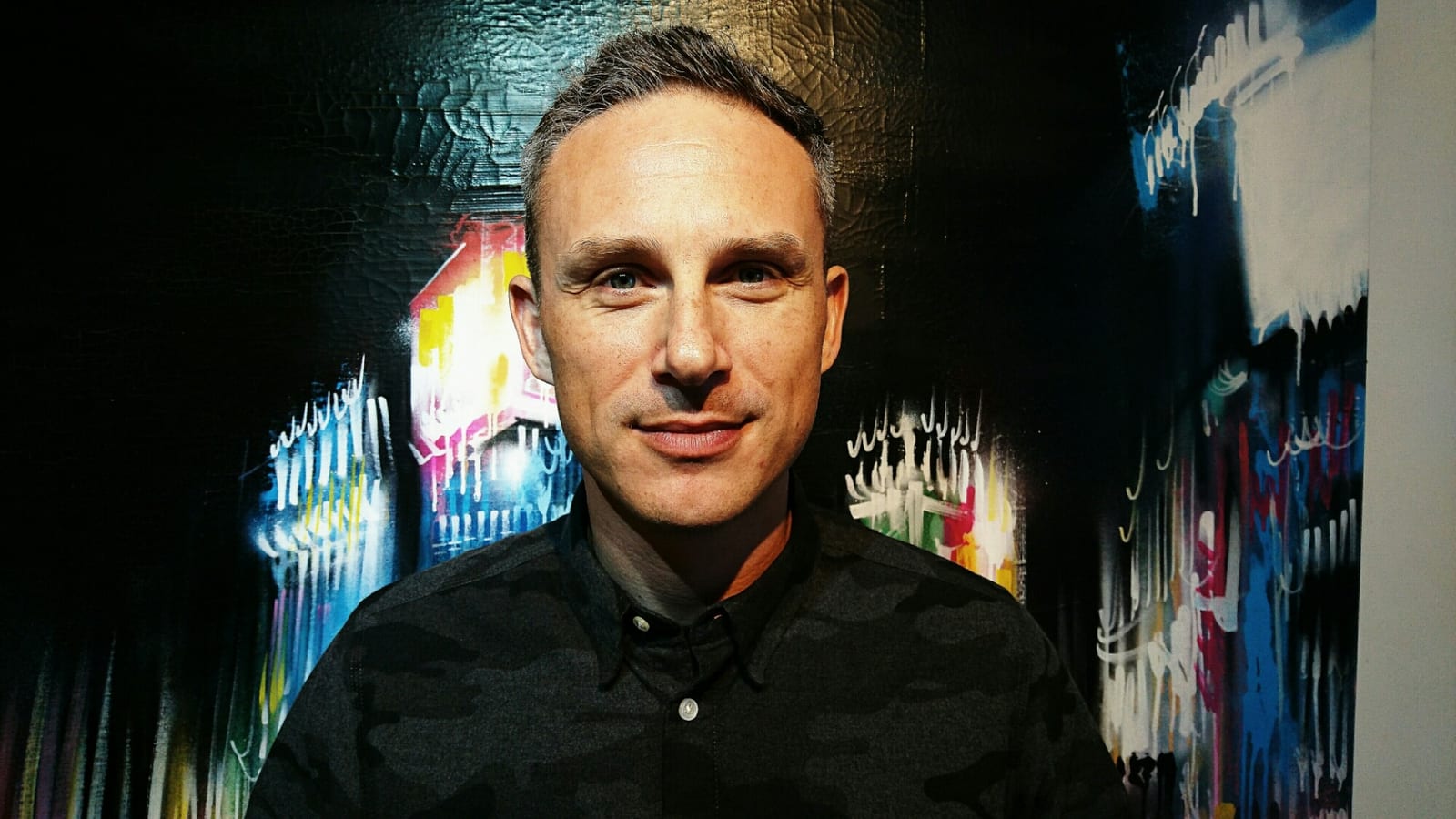
Most street artists want to be seen. Dan Kitchener wants you to feel the rain.
The Essex-born muralist has spent the better part of two decades painting walls across five continents, and the thread running through almost all of it is the same: neon light bleeding into wet pavement, figures moving through downpours, the particular glow of a city street at two in the morning when the rain has just stopped and everything reflects. It is a visual language so specific and so fully realized that you can identify a Kitchener from across a street before you have read a single caption.
That kind of signature is rare in any art form. In street art, where the pressure to be loud, graphic, and immediately legible is enormous, it is almost unheard of. And yet Kitchener has built it quietly, methodically, and entirely on his own terms.
Kitchener did not come up through a fine art program or a graffiti crew. He is largely self-taught, and his education has been the world itself. His travels to Tokyo, Hong Kong, Vietnam, New York, and Miami have not just inspired his work; they have become the raw material for it. He photographs obsessively on the road, capturing the candid, unposed moments he is drawn to: a figure crossing a rain-slicked alley in Shinjuku, a vendor in Hoi An framed by the blasting white light of midday, the Pulaski Skyway bridge in Jersey City catching the last of the sunset after a long day on the wall.
Those photographs become the foundation for his freehand digital paintings, which he creates on an iPad Pro using Procreate, and eventually for the murals themselves. The process is not about copying a reference. It is about distilling a feeling, the specific quality of light and atmosphere that made him stop and reach for his camera in the first place, and then scaling it up to the size of a building.
"I am fascinated by capturing these unposed, natural moments in time."
That fidelity to lived experience is part of what separates Kitchener from artists working in a more purely graphic or conceptual tradition. His work is representational in the deepest sense: it is trying to put you somewhere real, somewhere he has actually stood, and make you feel what he felt standing there.
Ask anyone who follows street art what they associate with Dan Kitchener and the answer is almost always the same: rain. Specifically, the way rain transforms a city at night, turning every surface into a mirror, multiplying every light source, and giving even the most ordinary street corner a kind of cinematic depth.
Kitchener has spoken about his affection for the UK's grey, wet weather, the motorways in the rain, the particular quality of English light on a damp evening. It is not a romantic cliche for him. It is a genuine visual obsession, one that he has pursued with the kind of consistency that turns a style into a world. His piece "Back to Reality," a freehand digital painting based on his rainy return to England after painting at Wynwood Walls in Miami, captures exactly this: the M25 in the rain, rendered with the same care and attention he gives to the neon-soaked alleys of Tokyo.
That willingness to find beauty in the mundane, to treat a British motorway with the same reverence as a Japanese backstreet, is one of the things that gives his work its emotional range. He is not just painting exotic locations. He is painting the feeling of being alive in a city, any city, when the light is right.
Kitchener's outdoor murals have taken him to some of the most celebrated street art destinations in the world. He has painted at Wynwood Walls in Miami, one of the most visited open-air street art museums on the planet. He has worked in Belfast, where his piece "Reflections" at the Ormeau Bridge became one of the most photographed murals in the city. He has painted in Deep Ellum in Dallas, in Jersey City, and most recently at Waterford Walls in Ireland in 2026, one of Europe's leading street art festivals.
But Kitchener's practice extends well beyond the street. His interior commission work spans continents and categories. He has painted the main lobby of the Rise Street Art Hotel in Larnaca, Cyprus. He has created Japanese street scene installations for a chain of sushi restaurants in Pittsburgh, using calligraphy pen and ink to bring the atmosphere of Tokyo's Golden Gai district to a dining room in Pennsylvania. He has worked in Shoreditch at the Calloo Callay bar, at the Goldman Global Arts head office in Miami, and at a Japanese restaurant in Corpus Christi, Texas.
The breadth of that client list reflects something important about how Kitchener has built his career. He has not positioned himself as a fine artist who occasionally condescends to commercial work. He has built a genuine practice that moves fluidly between the street, the gallery, and the interior design world, bringing the same visual intelligence and the same obsessive attention to light and atmosphere to every context.
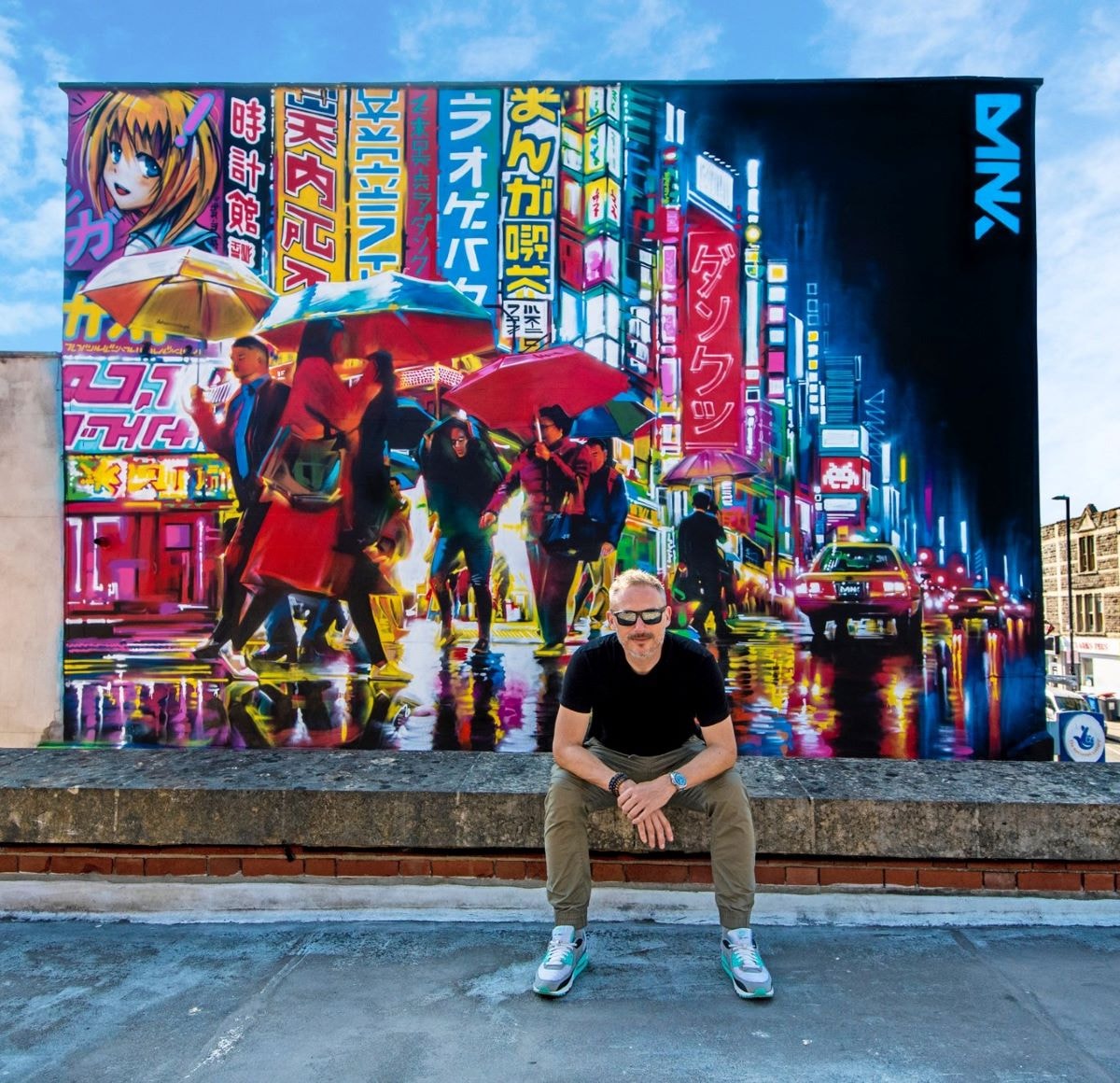
Recurring through Kitchener's work is a cast of figures that have become almost emblematic: geishas, street-level pedestrians, riders on motorbikes, women in traditional dress caught in modern urban settings. The geisha in particular appears across his murals, his canvas work, and his print editions, always rendered with the same combination of delicacy and scale, a face that commands a wall the way a portrait commands a room.
These figures are not decorative. They are the emotional anchor of the work. In a Kitchener mural, the human presence is what gives the light somewhere to land. The rain, the neon, the reflections: all of it is in service of the figure moving through it, and the feeling of solitude and beauty that comes from being a single person in a vast, luminous city.
His original canvas work carries the same weight. Pieces like "Geisha Beauty," "Rainy Days," and "Painted Lady" are not studies or sketches. They are fully realized paintings that hold their own in any gallery context, priced accordingly and collected seriously. His limited edition prints, hand-finished and signed, have built a secondary market of collectors who follow his work closely and sell out quickly when new editions drop.
One of the less-discussed dimensions of Kitchener's practice is his commitment to passing on what he has learned. His mural artist training program, offered through his website, is aimed at artists who want to make the transition from studio work to large-scale exterior painting, one of the most technically demanding shifts in the visual arts. Scaling a composition to the side of a building, working with spray paint in changing weather conditions, managing perspective at heights: these are skills that are almost impossible to learn from a book, and Kitchener has built a curriculum around teaching them directly.
That generosity with knowledge is consistent with the way he presents himself more broadly. He is not a mystifier. He talks openly about his process, his tools, his references, and his influences. He posts work in progress. He credits his photography. He is, in the best sense, a working artist who wants other working artists to succeed.
There is a version of a street art career that is built on novelty: a new concept, a new technique, a new controversy, something to keep the algorithm fed and the press interested. Kitchener has built the opposite. His career is built on depth, on returning to the same set of obsessions with increasing skill and confidence, and trusting that the work will find its audience.
It has. His murals are photographed and shared by people who have no idea who painted them, drawn in by the image before they ever look for a signature. His prints sell out. His commissions take him to five continents. And his visual language, that specific combination of rain, neon, figures, and the particular quality of light on a wet street at night, has become genuinely iconic in a field where most signatures fade within a few years.
The rain keeps falling. The walls keep going up. And somewhere on a building in a city you may never visit, Dan Kitchener is making it beautiful.
Sources: dankitchener.com, Waterford Walls 2026, Wynwood Walls, Goldman Global Arts.
About the author
Liz PlummerLiz Plummer writes about the artists, designers, and creative entrepreneurs reshaping culture from the outside in.