Creative Profiles
Shepard Fairey: From OBEY to a Global Creative Empire
Tamara Edwards9 min read
By placing everyday people in poses reserved for kings and presidents, Wiley has transformed one of art history's oldest genres into a powerful statement about who deserves to be remembered.

Arts & Business Contributor
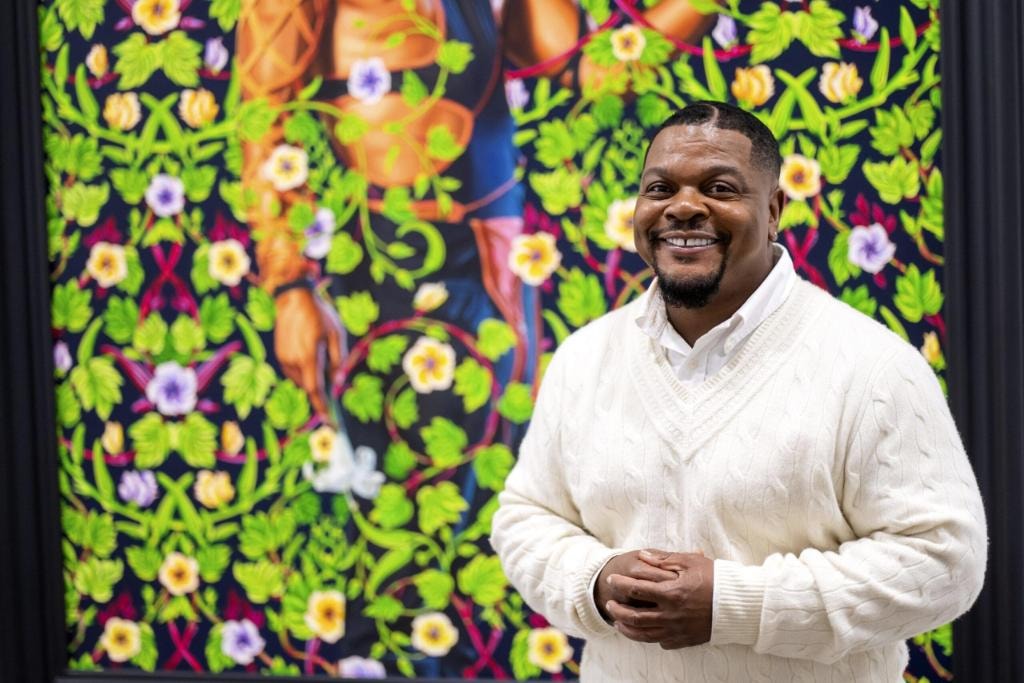
Few contemporary artists have reshaped the conversation around portraiture as profoundly as Kehinde Wiley. Renowned for his monumental paintings that place everyday people in the poses traditionally reserved for kings, queens, military leaders, and aristocrats, Wiley has transformed one of art history's oldest genres into a powerful commentary on identity, representation, and cultural legacy.
His work asks a deceptively simple question: Who deserves to be remembered? By borrowing the visual language of European Old Master paintings and replacing their historical subjects with contemporary individuals from around the world, Wiley challenges centuries of convention while creating images that are both visually breathtaking and culturally significant.
"I want to create a conversation between the past and the present, between the powerful and the powerless."
Throughout his career, he has photographed people he encounters in cities across the globe, inviting them into his studio before portraying them against elaborate decorative backgrounds inspired by textiles, wallpaper, botanical motifs, and historical ornamentation. The resulting portraits blur the line between classical tradition and contemporary culture. Rather than merely referencing art history, Wiley rewrites it.
In 2018, Wiley became the first Black artist commissioned to paint the official presidential portrait of Barack Obama for the Smithsonian's National Portrait Gallery. The portrait departed dramatically from traditional presidential imagery. Rather than depicting Obama within a formal government setting, Wiley surrounded him with vibrant foliage representing places central to his life and heritage. The painting became an instant cultural landmark, attracting record attendance and introducing Wiley's work to millions of people around the world.
Beyond his own artistic practice, Wiley has established a global studio model that allows him to execute ambitious projects while maintaining extraordinary technical standards. His work spans painting, sculpture, stained glass, and monumental public commissions, with exhibitions throughout North America, Europe, Africa, and Asia.
Although Wiley's practice remains firmly grounded in fine art, his influence extends into fashion, design, publishing, philanthropy, and cultural institutions. Organizations are drawn not simply to his aesthetic, but to the ideas his work represents. His paintings communicate excellence, dignity, craftsmanship, and inclusion.
Kehinde Wiley has accomplished something rare in contemporary art. He has created work that feels timeless while speaking directly to the present. His portraits honor classical technique without being confined by tradition. They challenge established narratives without sacrificing beauty. And they remind viewers that representation is not simply about who appears in a painting, but about who is seen, remembered, and celebrated throughout history.
About the author
Liz PlummerLiz Plummer is an executive producer, creative director, and arts contributor. She covers contemporary artists, design, architecture, creative entrepreneurship, and the cultural forces shaping modern business.