
Creative Profiles
Shepard Fairey: From OBEY to a Global Creative Empire
Tamara Edwards9 min read
From a psychiatric institution in Tokyo, Kusama has built one of the most commercially successful and critically respected art practices in the world. The story of the artist who turned repetition into an empire.

Arts & Business Contributor
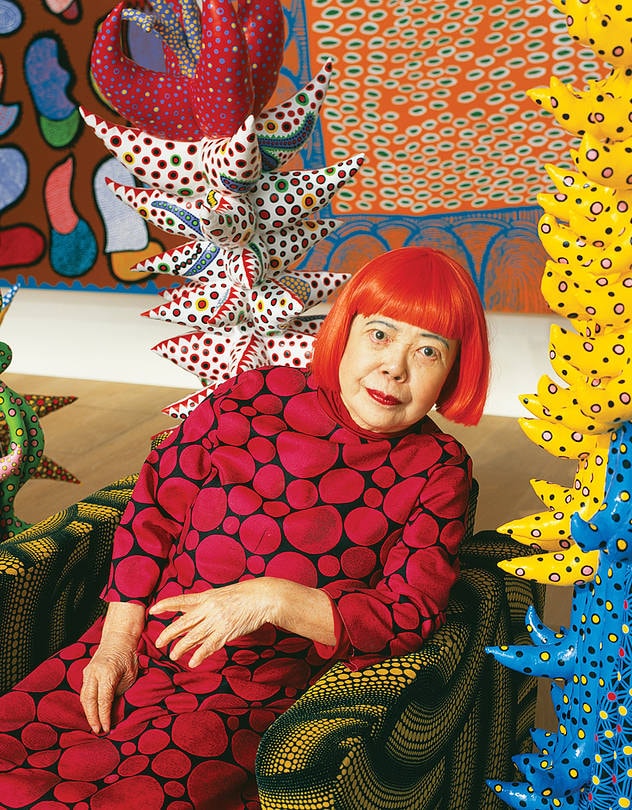
There are artists who become famous. There are artists who become brands. And then there is Yayoi Kusama, an artist who has become, at 97, something closer to a cultural force of nature.
Born in Matsumoto, Japan in 1929, Kusama began drawing obsessively as a child, covering surfaces in dots and nets as a way of managing the hallucinations she experienced from an early age. What began as a coping mechanism became a lifelong artistic language. The polka dot, endlessly repeated, endlessly varied, is now one of the most recognizable visual signatures in contemporary art.
"I want to show that art heals. I want to show that art saves lives."
Kusama moved to New York in 1958 and spent the 1960s at the center of the avant-garde, staging happenings, creating infinity net paintings, and building immersive environments that anticipated the experiential art movement by decades. She was radical, prolific, and largely overlooked by the mainstream art market. In 1973, she returned to Japan and voluntarily entered a psychiatric institution in Tokyo, where she has lived ever since, continuing to work every day from a studio across the street.
The second act of her career has been extraordinary. Beginning in the 1990s and accelerating through the 2000s and 2010s, her work was rediscovered by a new generation of collectors, curators, and eventually the general public. Her Infinity Mirror Rooms, immersive installations in which mirrored walls and LED lights create the illusion of infinite space, became some of the most photographed and visited artworks in the world. Museum exhibitions sold out months in advance. Lines stretched around city blocks.
The commercial dimension of her practice has been equally remarkable. Her 2012 collaboration with Louis Vuitton, conceived with Marc Jacobs, was one of the most successful artist-brand partnerships in fashion history. Polka-dotted bags, shoes, and accessories sold out globally. The collaboration was revived in 2023 with a new collection and a series of immersive retail installations that turned Louis Vuitton flagships into Kusama environments. Animatronic figures of the artist appeared in store windows worldwide, painting dots in real time.
What makes her commercial success remarkable is that it has not diminished her critical standing. She remains one of the most exhibited living artists in the world, with major retrospectives at the Tate Modern, the Whitney Museum, and the Museo Reina Sofia drawing record attendance. The work that sells millions of dollars of luxury goods is the same work that fills museums. The dots are the same dots.
Kusama's story is also a story about persistence across an extraordinary span of time. She has been making art for more than seven decades, through periods of obscurity and periods of global celebrity, through changing art markets and changing cultural tastes. The consistency of her vision, the dots, the nets, the infinity rooms, the pumpkins, has become its own kind of power. In a world that rewards novelty, she has built an empire on repetition.
About the author
Liz PlummerLiz Plummer is an executive producer, creative director, and arts contributor. She covers contemporary artists, design, architecture, creative entrepreneurship, and the cultural forces shaping modern business.